8 July 2026
Balance and falls prevention: why over-60s love the reformer
Here is a myth worth retiring: that balance is simply something you lose with age, the way hair goes grey. The truth is more hopeful and more practical. Balance is a skill, built from leg strength, ankle control, core stability and practice, and like any skill, it fades when it stops being used and rebuilds when training resumes. That rebuilding is some of the most valuable work we do at The Old Dairy, and it is why so many of our members are in their sixties, seventies and beyond.
Why balance quietly fades
Modern life slowly removes balance practice without asking. We stop kneeling to garden, take the car instead of the uneven footpath, hold the handrail, avoid the wobbly moments. Each avoidance is sensible on its own, and together they mean the balance system, the ankles, hips, eyes and inner ear working in concert, simply stops getting rehearsals. Then one day a kerb or a loose rug asks a question the body has not practised answering.
Why the reformer is such a good place to train it
The obvious problem with balance training is that practising the thing you are afraid of, wobbling, feels unsafe. The reformer solves this elegantly:
- The carriage teaches control lying down first. Long before you stand on anything, footwork and leg presses build the strength in the hips, thighs and ankles that steadiness is made of.
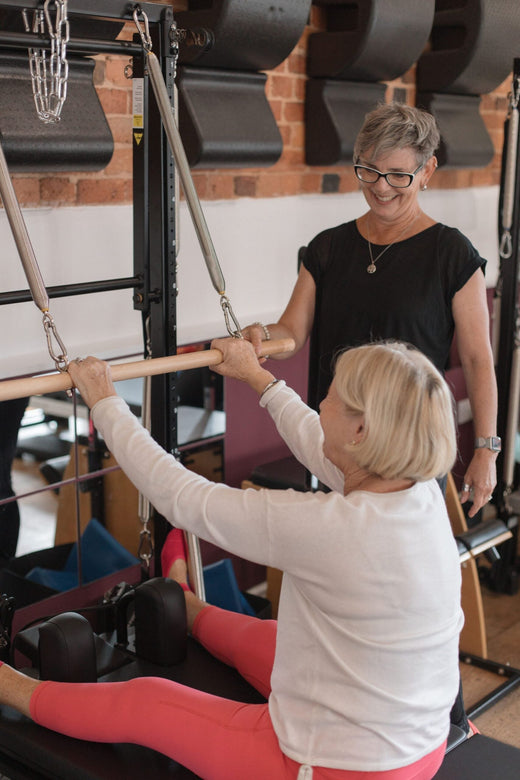
- Instability arrives in careful doses. A moving carriage under your feet challenges your stability in a completely controlled way: hands supported, range limited, springs assisting.
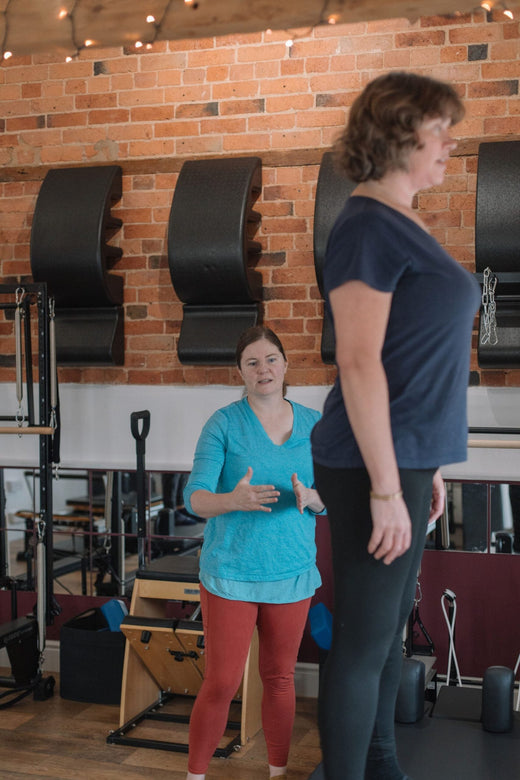
- Standing work has support built in. Work at the Pilates chair and the tower gives you something stable to hold, or hover near, while your legs and ankles do the balancing. Confidence grows because the safety net is right there.
Strength is half of balance
Studies of falls consistently point at two trainable factors: balance practice and leg strength, especially the power to catch yourself, that quick step that turns a stumble into a story rather than an injury. Our work builds both: slow strength through footwork and bridging, and quicker, coordinated movement as you progress. It is not about becoming an athlete. It is about a body that answers quickly when the pavement asks.
The part nobody measures: confidence
Fear of falling changes how people walk, shorter steps, eyes down, weight back, and those changes ironically make falls more likely. What our members often notice first is not a measurement but a feeling: stairs without the handrail, the garden in winter, carrying the tray without thinking about it. Moving through the world with your head up again.
Where to start
You do not need to be steady to start; you need to start to be steady. With four people at most in every class, there is always an instructor beside you, a hand nearby, and a version of every exercise that meets your balance exactly where it is today. Come and feel your feet under you again, starting the way everyone here starts: an hour, one to one.