12 July 2026
Knee pain and reformer Pilates: strength without impact
Knees have a hard reputation to shake. Once one starts complaining, on stairs, on cold mornings, on the walk back down the hill, most people respond by asking less of it. Less walking, fewer stairs, no more kneeling in the garden. It feels sensible. But knees rarely hurt because they are overworked. They far more often hurt because they are under-supported, and asking less of them makes the support weaker still. The way out of that spiral is strength without aggravation, and that is the reformer's home ground.
An honest note first: knee pain has many causes, and some, a significant injury, a locked or giving-way knee, sudden swelling, need a professional diagnosis before exercise. If you are post-surgery, including knee replacement, we will happily work alongside the guidance of your surgeon or physiotherapist. Tell us your history and we will build around it.
Why the reformer suits sore knees
The exercise a sore knee needs, repeated, controlled bending and straightening under manageable load, is exactly what walking, squatting and stairs provide too much of, too soon, with all of your bodyweight involved every time. The reformer changes the arithmetic:
- The springs decide the load, not gravity. Lying on the carriage doing footwork, you can press with a fraction of your bodyweight, and increase it one spring at a time as the knee adapts.
- No impact, ever. The carriage glides. There is no jarring, no pounding, no landing.
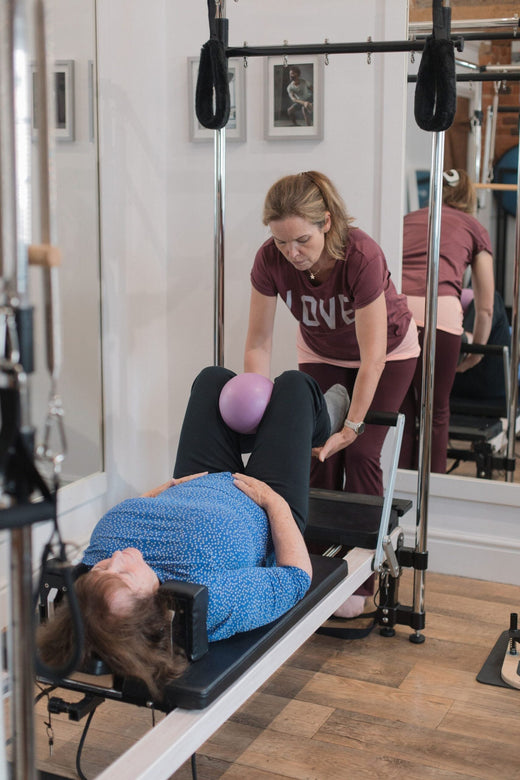
- Alignment is coached on every rep. A great deal of knee pain involves the knee drifting inward as the leg bends. On the reformer, your instructor can watch and correct your tracking rep after rep, so the joint practises moving well.
The muscles that protect the knee
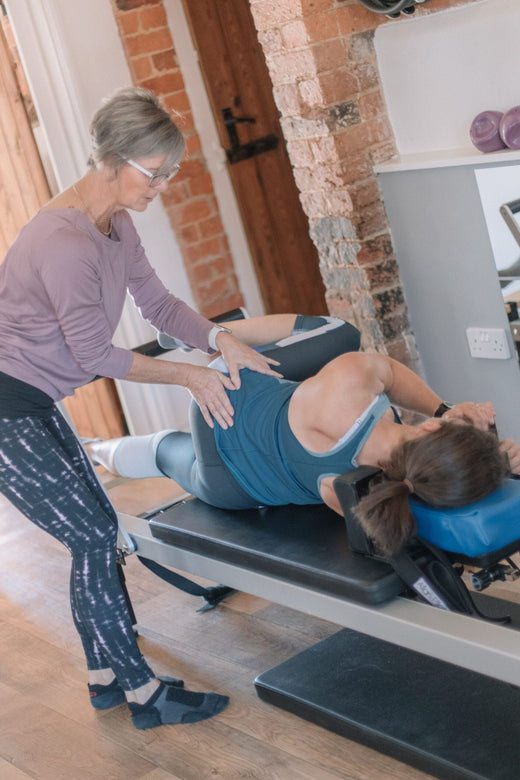
The knee is a hinge caught between two bosses: the hip above and the foot below. When the glutes are weak, the thigh rotates and the knee follows; when the foot is lazy, the arch collapses and drags the knee with it. So knee work at The Old Dairy is mostly hip, thigh and foot work: bridging and side-lying series for the glutes, footwork in different foot positions for the quads and calves, and precise foot placement so the whole leg learns to stack well. Strengthen the neighbours and the knee stops paying their bills.
Rebuilding trust
A knee that has hurt for a long time is a knee you stop trusting, and the hesitancy shows: weight shifted to the other leg, stairs taken one at a time, the deep bend avoided entirely. Part of what the reformer rebuilds is simply confidence, the accumulating experience of the knee bending, loading and straightening comfortably, hundreds of times, until your nervous system stops flinching first.
Where to start
Do not wait for the knee to feel better before you begin; beginning is usually how it starts to feel better. In our small classes the springs will meet your knee exactly where it is, and move forward only at its pace. Gently, rep by rep, we will help you take the stairs like you used to.