18 July 2026
Pilates for golfers: rotation, balance and a stronger swing
Every golfer wants two things from their body: a fuller, freer turn, and a back that is still on speaking terms with them at the eighteenth. The frustrating truth is that most attempts to swing harder work against both, because power in golf does not come from arms or effort. It comes from rotation, generated in the hips and mid-back, stacked over a stable base. Which happens to be a near-perfect description of what reformer Pilates trains.
The golfer's equation: mobile in the middle, stable underneath
A good swing asks different body parts for opposite qualities. The hips and thoracic spine, the mid-back, must rotate generously. The pelvis and core must stay stable enough to give that rotation something to wind against. Most amateur swings have the equation backwards: a stiff mid-back that cannot turn, compensated by a lower back that turns too much. The mid-back tolerates rotation happily; the lower back does not, which is why golf and lower-back pain are such old companions.
How the reformer rebuilds the turn
- Thoracic rotation, restored. Seated and kneeling rotation work with the straps takes your mid-back through controlled turning under light spring load, mobilising and strengthening the turn at the same time. More turn from the right places means the lower back can finally hand its extra workload back.
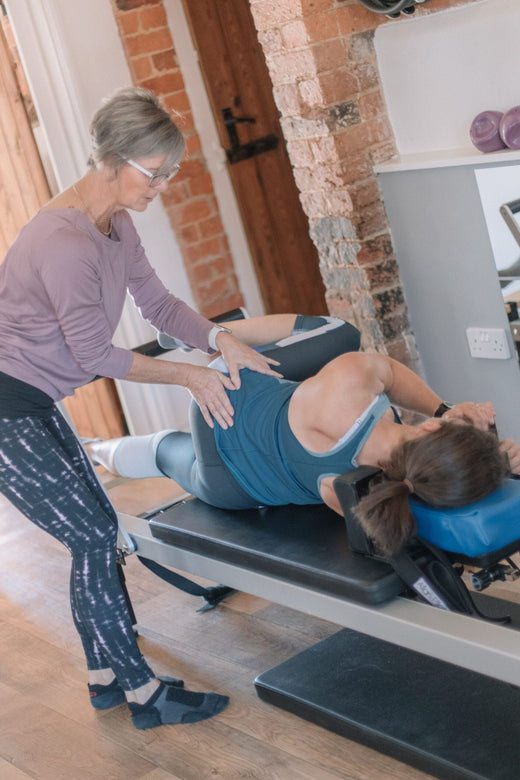
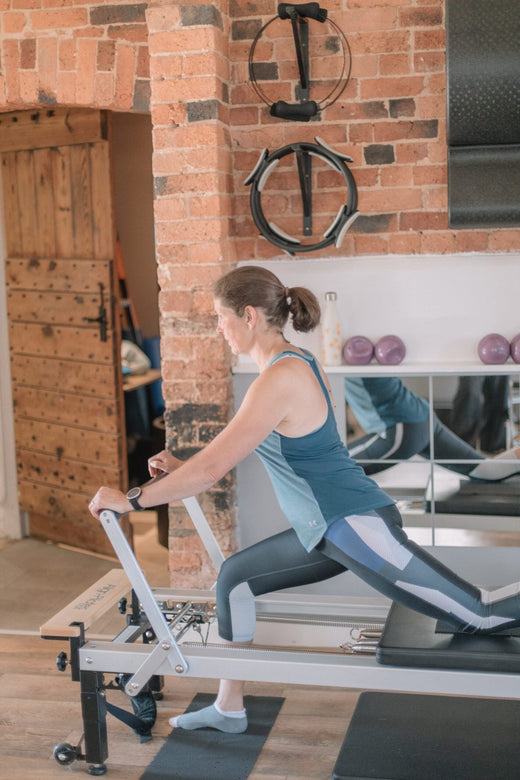
- Hips that load and release. The swing is a weight shift: load the trail hip, fire through to a balanced finish. Lunging patterns, single-leg footwork and side-lying hip series build hips that can accept load and release it in sequence.
- A core that transfers, not just braces. Golf needs anti-rotation strength, the ability to control rotation, not merely resist it. Kneeling and standing spring work trains your trunk to transfer force from the ground to the club without leaking it through a wobbling middle.
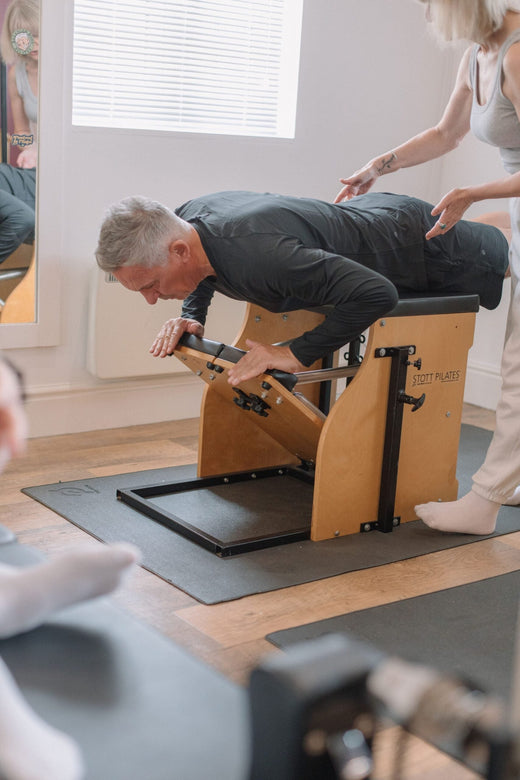
- Balance to swing within. You can only swing as hard as you can balance. Standing work on the carriage and at the chair steadies the base that every good strike is built on.
Eighteen holes is an endurance event
A round is four-plus miles of walking punctuated by around a hundred maximal rotations, and the mishits multiply as posture tires. The postural endurance built on the reformer, the ability to keep your spine tall and your setup consistent in the fifth hour as in the first, may quietly be worth more shots than any swing change.
Where to start
You do not need a golf-specific programme; you need the rotation, hip mobility and balance that our regular small classes already build, with your instructor knowing what you are training for. Tell us about your game, and somewhere around the third week, watch what happens to your turn.